Short answer
Padel courts can be built safely by the sea and in humid climates when the steel is hot-dip galvanized and coated for the site's corrosivity category (C4–C5 under ISO 9223/12944), fasteners are A4 (316) stainless, and the structure is calculated for local wind. Regular fresh-water rinsing keeps salt from building up.
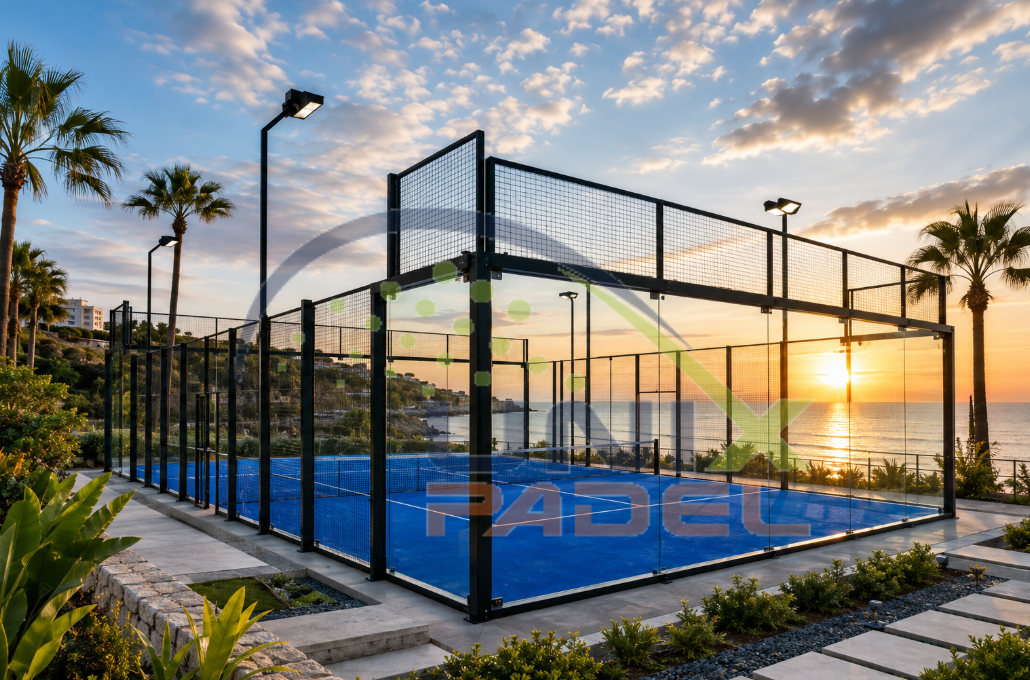
Beach clubs, seaside hotels and tropical resorts are some of the best places to run padel courts, and some of the hardest environments for steel and glass. Salt, humidity and wind attack a court every day. The good news: with the right specification, a coastal court lasts as long as an inland one.
What makes coastal sites hard on padel courts?
- Salt: airborne chlorides settle on the structure and accelerate corrosion wherever bare steel is exposed, at scratches, cut edges, welds and fixings.
- Humidity and condensation: moisture stays on surfaces for longer, especially inside hollow sections and under fixings.
- Wind: open coastlines see strong, gusty winds that load the glass panels and the anchors.
- Sun and UV: fade coatings, turf and nets faster than inland.

How do you protect a padel court by the sea?
Start by classifying the site. ISO 9223 and ISO 12944 rank atmospheres from C1 (very low) to C5 (very high) and CX (extreme, offshore). Most seafront sites are C4 or C5, and the coating system should be specified for that category.
On that basis, a coastal court should combine:
- Hot-dip galvanizing after fabrication (ISO 1461): every surface, inside and out, including welds and cut edges, coated with zinc.
- A heavier powder coating system on top of the zinc, specified for the site’s corrosivity category.
- A4 (316) stainless steel bolts and nuts, which avoid rust streaks around fixings.
- EPDM rubber gaskets between glass and steel, which resist UV and salt.
- Drainage and ventilation of hollow sections, so water cannot collect inside the frame.
How does a coastal specification differ from a standard court?
| Component | Unixpadel standard court | Unixpadel coastal specification |
|---|---|---|
| Frame protection | Hot-dip galvanized (ISO 1461) + powder coating | Hot-dip galvanized + heavier coating system for C4–C5 |
| Fasteners | Galvanized steel | A4 (316) stainless steel |
| Glass gaskets | Rubber gaskets | EPDM gaskets |
| Structure | 100 x 50 mm columns and beams, three-pillar corners, 120–140 km/h wind rating | Site-specific static calculation; reinforced WP Challenge frame for very exposed sites |
| Turf and net | UV-stabilised | UV-stabilised, checked more often |
Even the standard Unixpadel court is hot-dip galvanized and powder coated; the coastal specification adds margin where salt and wind are strongest. Why galvanized structural steel is preferred over stainless frames is explained in steel types for padel courts.
What about wind?
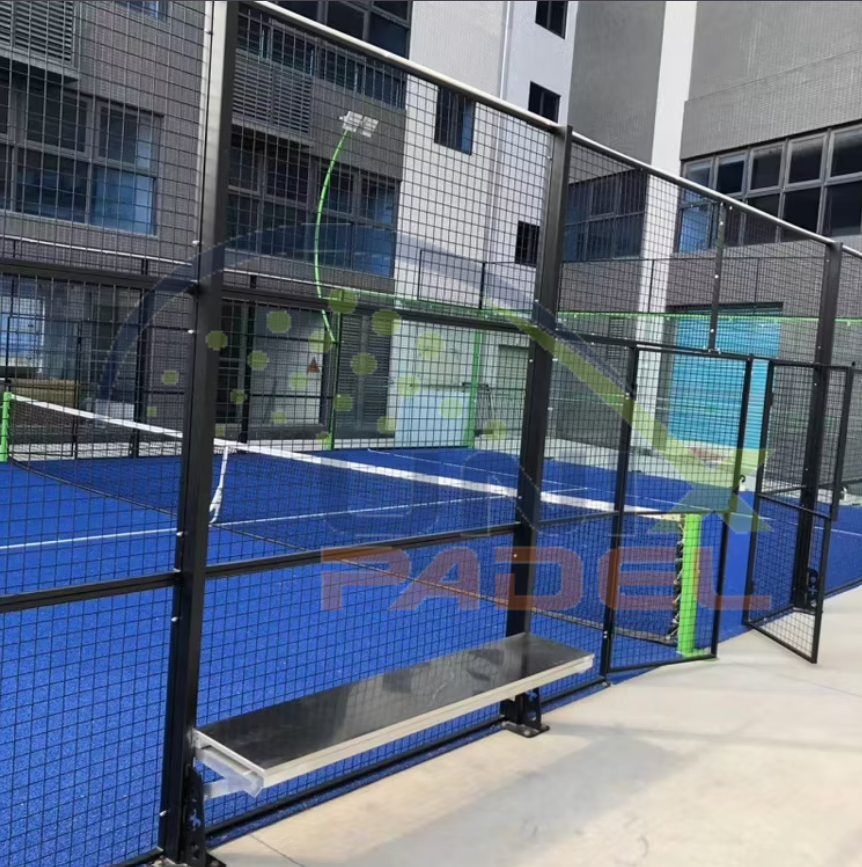
Coastal wind is often the larger risk. Ask for a static calculation for your exact location: Unixpadel courts are supplied with static analysis approved by Istanbul Technical University (ITU). On exposed sites, a court with reinforced corners such as the WP Challenge court and a well-anchored perimeter beam keep the glass stable. If you plan a canopy, it must be calculated for the same wind.
How should a coastal court be maintained?
- Rinse the frame, mesh and glass with fresh water every few weeks, and after storms.
- Inspect the coating every three months and touch up any scratch before rust spreads.
- Check fixings and gaskets twice a year.
- Brush and top up the turf sand more often, as wind removes it faster.
The full routine is in padel court maintenance.
Planning a coastal padel project?
Send us the site location and exposure (distance from the sea, prevailing wind), and Unixpadel’s engineering team will recommend the structure, coating and fixings for your court.